Alliance of International Property Owners

Menu

  • Home
  • Buyers
    • Freehold/Leasehold
    • Timeshare
    • Benefits of buying through an AIPP property professional
    • Overseas Mortgage Information
    • Currency Transfers
    • Financial Planning
    • Search the AIPP Member Directory
    • Downloads
  • Owners
    • Freehold/Leasehold
    • Timeshare
    • Downloads
    • Advice, information and offers from our professional partners
  • Blog
  • Podcast
  • Free Legal Advice
  • Search Properties
  • Sign up
  • Search

The Alliance of International Property Owners

Home|Blog|What Official Property Data Misses in Thin, Ultra-Prime Markets

Search the Alliance for Information & Inspiration

Explore our site to find answers, offers, ideas and news

Close

Buy right, own well

Association of International Property Professionals (AIPP)
AIPP is the trade body improving standards for buyers and is the key supporter of the AIPO; providing a safer environment for owners and buyers of a foreign property.

Search for an AIPP Member Search for Properties

Search the AIPP member directory with confidence for a member to assist your property purchase, or browse AIPP member agent properties for sale. Please note: Whilst we make our best efforts to ensure all properties listed are only those of AIPP members, some may have been provided by non-AIPP members in collaboration with AIPP members on a shared listings or some other basis. If you are in any doubt about the provenance of a property please ask your agent directly. AIPO and AIPP accept no liability for properties listed on the AIPO website, always use a good, independent lawyer to advise you on any property transaction.

Close

Download your guide

  • Download your free guide here (We’ll also send an email with a link to your guide so that you can read it anytime)
  • AIPO recognise that your privacy is important and are committed to protecting it. We therefore comply with the General Data Protection Regulations (GDPR). For further information about how we store and use your personal data, please read our privacy policy.
  • This field is for validation purposes and should be left unchanged.
Close

What Official Property Data Misses in Thin, Ultra-Prime Markets

Accurate Property Prices in Spain

When you start researching a destination to buy property abroad, the national price index is usually the first number you meet — and often the last one you question. For a country’s mainstream housing market, trading tens of thousands of homes a quarter, that index is a reasonably reliable guide. Drop into a small, discreet, ultra-prime enclave, and the same instrument can start telling you something close to the opposite of what’s actually happening on the ground.

That isn’t a flaw unique to one country or one statistics office. It’s a structural feature of how most housing data is built, and it matters most in exactly the markets international buyers are often most drawn to: gated communities, coastal enclaves and country-house pockets where very few properties change hands each year, and where privacy is often part of the appeal.

Why the Lag Happens

Across much of Europe, official property price statistics are built from registered or notarised deeds — the point at which a sale is legally completed, not the point at which buyer and seller agree terms. For a straightforward resale, that gap is usually short. For an off-plan or new-build purchase, it can run well over a year, since the deed can’t be signed until construction finishes and paperwork clears.

Layered on top of that timing lag, many statistical methodologies also exclude outlier transactions above a certain price or price-per-square-metre threshold, on the reasonable grounds that a handful of very high-value sales shouldn’t distort an average built for a whole national market.

Both conventions make sense applied at scale. Applied to a market recording a few hundred sales a year instead of a few hundred thousand, they behave very differently — a handful of delayed or excluded transactions isn’t noise anymore. It can be the whole trend.

A Case in Point: Sotogrande, Spain

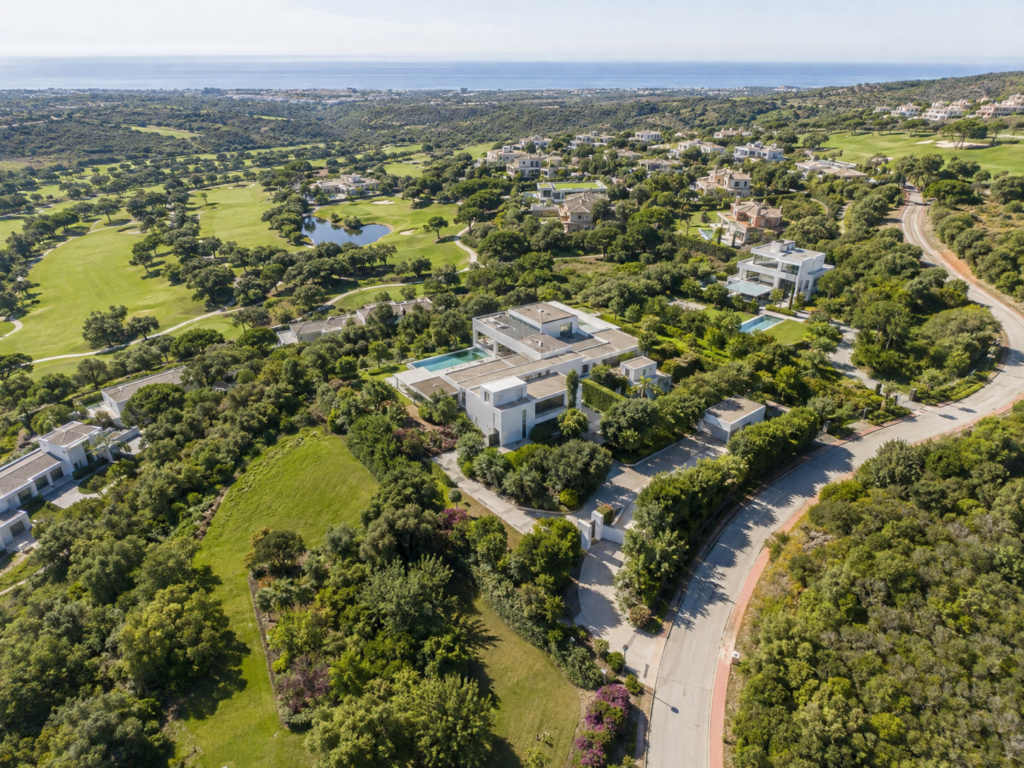
Sotogrande, on Spain’s Costa del Sol in Cádiz province, is a useful illustration precisely because the gap is measurable. Official notarial data for the area’s postcode (11310) shows 196 sales in the twelve months to May 2026, at an average of €3,043 per square metre — already a 54.9% premium over the Cádiz provincial average of €1,964/m², reflecting how differently this micro-market trades compared with the province it technically sits inside. Against that backdrop, the same official data shows Sotogrande’s annual price change at -4.54%.

Three verified, fully public villa sales inside a single gated enclave within the area — sold for €23.75 million, €14 million and €12.5 million respectively, together spanning roughly 9,000m² of built area — do not yet appear in that figure. Two are recent private transactions; the third, an off-plan record sale independently reported by multiple outlets, sits permanently above the threshold most notarial statistics exclude from their averages.

Recalculating with those three sales included — a floor, not a ceiling, since it only accounts for transactions that are independently verifiable — moves the area’s total transacted value up 33.8%, its average sale price up 31.7%, and its annual price change from a reported decline of 4.54% to an estimated increase of over 7.5%: a swing of more than 12 percentage points from three transactions alone. And because Sotogrande also sees property change hands through company-share sales, which never enter notarial records at all, the true gap is very likely wider than this — it simply isn’t provable beyond what’s shown here.

None of this means the official figures are wrong, exactly. The methodology does what it was designed to do: measure completed, notarised transactions consistently across every market in the country. It just wasn’t built to capture a market this thin with much precision — and the smaller and more private the market, the larger that blind spot gets.
What This Means If You're Buying

The takeaway for anyone researching a niche or ultra-prime destination isn’t to distrust official statistics outright — it’s to treat a national or regional index as a starting point, not the final word, once the market in question gets small enough. A few practical habits help close that gap:

  • Ask a local agent for realised transaction data, not just asking-price listings — actual agreed prices tend to move ahead of what shows up in registries.
  • Where a destination trades heavily in off-plan or new-build stock, expect official figures to lag current market conditions by a year or more.
  • If a market is known for privacy or company-structured ownership, assume official volume understates real activity, and weight that market’s own specialists’ on-the-ground read accordingly.
  • Cross-check a headline percentage against the underlying sale count. A “decline” built on a few hundred transactions carries far less statistical weight than the same headline built on tens of thousands.

None of that requires ignoring the data. It just means reading it at the resolution the market actually operates at, rather than the resolution the statistics office had to average it down to.


Innin Buyl is Director of Sales at Open Frontiers, a Sotogrande-based real estate agency founded in 1996, and a Colegiada API (COAPI) and CEPI-accredited property professional specialising in the Sotogrande market and its surrounding areas of the Costa del Sol. Official baseline figures referenced above are drawn from the Consejo General del Notariado’s Portal Estadístico and the Registradores de España’s Estadística Registral Inmobiliaria. A fuller version of this analysis, including a wider comparison against other prime European enclaves, is available on Open Frontiers’ market intelligence pages.

About Open Frontiers

Open Frontiers is an independent, second-generation real estate agency based in Sotogrande, established in 1996 with 30 years of experience in the local property market. A specialist in the Sotogrande property market and surrounding areas, the agency is a Colegiado API, holds GIPE accreditation, is represented at European level through CEPI, and is a member of AIPP.

Open Frontiers was named Best Real Estate Agency (Single Office) in Spain at the International Property Awards in both 2023–2024 and 2024–2025. Its multilingual team provides residential property advisory services and publishes regular market intelligence on Sotogrande pricing, transactions, trends and buyer behaviour.

Open Frontiers Real Estate | www.openfrontiers.com | hello@openfrontiers.com

Related BLOG

View all
  • Andalucia, Buying, Costa del Sol, Golf, Investment, Property Investment, Retirement, Sotogrande, Spain|28 May 2026

    Costa Del Sol property expertise for more than 20 years

    For more than two decades the Mitchell family have been helping people find their dream property in Spain. Their Youtube channel is a must-watch for anybody considering a property on the Costa del Sol.

    Read more
  • AIPP Member News, Brexit, Buying, Italy, Lifestyle, Owning, Sicily|14 May 2026

    Buying a House in Sicily is Easier Than Buying a Car

    It sounds like the punchline to a joke, but there really is truth to this surprising claim.

    Read more

More from us

  • Buyers
    • Freehold/Leasehold
  • Owners
    • Freehold/Leasehold
  • Free Legal Advice
    • Buyers and Owners Legal Advice Enquiry Form
    • Downloadable Guides
  • About us
    • Advice, information and offers from our professional partners

Are you a property professional interested in joining AIPP?

Email: enquiries@aipp.org.uk
Web: www.aipp.org.uk

Alliance of International Property Owners Ltd trading as Advice on International Property Ownership
Email: info@aipo.org.uk

AIPO is registered at Companies House No. 10380594
AIPO is registered with the ICO - Information Commissioners Office No. ZA334523

  • Our Policies
  • Sitemap
Site by Valiant